Dark Road
The Child of Destiny
The boy had been told what he was so many times that he had stopped hearing it.
"The child of destiny? Me?"
The man in the cloak said that he was, and said it in the tone of somebody repeating a fact about the tide. "You've told me that a hundred times. But what's a child of destiny?"
He got an answer, and the answer was about saving the world and connecting with a great many others, and the boy turned it over and could find nothing in it he could use. "I don't get it," he said.
He was small and would not stay small. Tan skin, silver hair swept back into spikes with the bangs falling messy over his forehead, and eyes that were silver too and had always been. He wore a black jacket, high-collared and sleeveless, with the tails cut to points, over a long white shirt with two thin black belts drawn round the middle. Baggy grey trousers stuffed into black boots. Long black armbands to the elbow.
The man who raised him had come for him when he was an infant and had brought him to the islands because darkness could not easily get at them there. He was to be kept there until he was old enough to go to the other worlds. The boy had been on the islands ever since.
The cloak stayed up. In every hour the boy could remember, the man kept the hood where it was.
He taught the boy about darkness and about light, and he taught it as though the two of them were a subject a person could get to the bottom of.
"When I get strong enough, will I get to see my mom again too?"
He had got to the end of what the islands could give him. "This world is just too small," he said, to nobody in particular.
And he dreamed. "That dream again," he said, flatly, the way a person reports a thing that has stopped being interesting. "I've been having the same dream over and over again for as long as I can remember."
In the dream there were people.
There was a boy with silver hair that curled, and a red scarf with a pattern of swirls in it wound round his neck, and he was always on his way somewhere. There was a girl with stars at her ears who argued with him and went with him anyway. There was a man in a black hat pulled down low enough that his eyes did not come into it. There was somebody with rose-coloured hair who was looking for a person and had been looking for a long time. And there was a boy with blond hair lying flat, younger than the rest of them, who went where they went.
He had names for them. Ephemer. Skuld. Brain. Lauriam. Ventus.
He had never met anybody by those names. But they did not feel to him like things he had made up. They felt like remembering, and so he carried them about as his own, because he could not think what else they would be.
He did not tell the man in the cloak about them. It occurred to him as little as reporting the weather to somebody standing in it. A person does not report their own memories to somebody else as though they were news.
And they were not frightening. The dreams were good. There were five people in them and they liked each other, and the boy woke up out of them into an island with one man on it and no other children at all, and went down to the water, and got on with the day.
The man died when the boy was somewhere in his early teens.
There was nobody else on the islands who had known him, and so there was nobody to tell, and the boy did the necessary things alone, and afterwards the islands held one person where they had held two.
Not long afterwards somebody came toward him.
This one was hooded too. "Who are you?" the boy said.
The figure did not answer that. He said instead that the boy should leave the islands, and he said it as though the matter had already been settled somewhere else and he was only bringing word.
Then he opened a way.
It stood in the sand and it was made of dark and it went somewhere, and the boy looked at it for a while, and then walked into it.
Alba and Ater
He came out into a city standing on water.
It went on. That was the first thing about it and the thing that took longest to stop noticing. Towns built up the sides of mountains, and the mountains themselves made of nothing but white and gold buildings packed one above another, and a citadel on the top of each, and beyond that another mountain of buildings and then another, out as far as the water went, which was as far as there was. Nearly every roof had a windmill fixed on it, so that the whole enormous thing was turning slightly, all the time. The sky over it was clear. It stayed clear.
Down in the paving there was a star.
He was taken in as a student under a Keyblade Master called Odin, alongside six others.
Odin was old. Grey eyes under bushy white hair that came down to his shoulders, and a white beard reaching his chest. A buttoned beige shirt and beige hakama, the top of it worked like a sash with a gold emblem at the centre held through a yellow ribbon. Black heeled boots. Over all of it grey-brown robes to the floor, hooded, the sleeves wide and drooping, and a large soft pointed hat in the same grey-brown with a wide brim and a lavender lining, worn at an angle that kept one of his eyes out of sight.
The students wore a uniform, more or less. High collar, two straps crossing the chest in an X with a charm where they met, a sash at the waist, and over that whatever outer coat belonged to the wielder wearing it, which was where the uniform stopped being one.
Xehanort's was a sleeveless black shirt cut close with a large grey X worked across it, armbands much shorter than the ones he had arrived in, and a black belt with a silver emblem at the front. Over it a hooded black coat, sleeveless, falling to the upper calf, trimmed and lined in a pinkish brown, belted at the middle in dark grey, with long rectangular lapels embroidered in gold and pinned back with red cord.
Eraqus wore white.
His hair was loose and untidy at the front. The coat was hooded and white and more decorated than it needed to be, slit wide up the back, belted in black, its lapels beige and gold-embroidered and pinned with turquoise cords. Under it a high-collared black shirt and a hakama mostly tan with a lighter hem, the top of it dark grey and folded like a sash with a gold emblem at the front. Black boots with gold heels.
He was late to almost everything.
He was also, in the estimation of everyone around him, the reason the class held together at all. He talked. He made things funny that were not funny. He did it on purpose and he did it hardest when there was least reason for anybody to be hopeful, and it worked.
And underneath it he already believed, at that age, that darkness was a thing to be got rid of entirely. He said it came down to his family. His grandfather had fought it too.
The two of them played at a board.
Alba and Ater, white and black, thirty-two pieces to a board. Sixteen silver and white on the one side and sixteen gold and black on the other, each piece carrying a symbol on its head, each one named after somebody.
They played it constantly and Xehanort won. "Keep an open mind, Eraqus," he said, over one of them. "Maybe then you'll actually beat me."
And later, in the same room, with the pieces still standing: "It's almost time for class."
The room was large and white-walled, with golden beams across it and windows and arches at the ceiling and two fans turning at the top of the space.
When they were not in it they went up the long stair the city called the Stairway to the Sky and sat at the top of it.
That was where most of it happened. The training happened where Odin put them; the rest of it happened up there, the part that turns people who are in the same room into people who look for each other. They sat above the water with the whole white and gold weight of the place stacked up behind them and the windmills going, and they talked, and years went past while they were doing it.
Eraqus was late to that too.
Odin asked Xehanort once why he wanted to be a Master. "I don't know why," he said. "But I have friends. I want to see again."
He asked Odin, more than once, how a person got to the other worlds.
There were four others.
Vor was short and pale, with turquoise eyes and dirty-blond hair cut to the chin, the bangs swept left, the side locks curled. A high-necked white shirt with gold trim, turquoise straps crossing at her chest, a pendant, a sash striped in yellow-brown and white. Puffy violet shorts, black socks, white boots with gold trim and the cuffs turned down. Over it all a long purple cloak, the colour running lighter and darker through it, patterned in bubbles, trimmed in gold and lined in blue, the sleeves wide, a heavy blue cord tied in loops at her back.
Hermod was pale, blue-grey at the eyes, his hair the same blue-grey and parted to the left and never quite in order. White high-collared shirt, orange straps crossing, black trousers into tall boots tipped with gold, an orange sash with a pendant on it. Over that a loose olive robe with gold trim and long yellow lapels, the sleeves black and puffed, the cuffs orange and gold.
Urd had amber eyes and straight grey hair to her shoulders, pulled back into a ponytail. A long-sleeved grey shirt with wide white cuffs, light grey trousers, and a long black coat with short sleeves that flared.
Bragi was a young man with red-brown eyes set like a cat's and ginger hair blown mostly over to his left. High collar, black shirt, a black jacket cut for training in, a wide grey belt, two tan straps crossing to make an X with a white pendant hung where they met. Loose black trousers, black shoes with white laces. Over it a loose blue jacket, hooded, the lapels white, the hood lined with white fur.
He did not say much.
Baldr was pale, with silver eyes and long white hair, feathery, falling to his shoulders behind and cut shorter in front so that it framed his face. A white jacket with a very large hood, clasped in gold. A thin black band round his upper left arm. Lapels embroidered in gold, bridged by an orange cord that ended in a tassel at the left. Under it a black vest over a white undershirt, loose blue straps crossing at the waist, a silver chain at the left hip, black gloves with the fingers cut off, dark grey trousers, tall black boots buckled in gold.
Seven Who Did Not Come Back
Two years or so after Xehanort came to the city, Odin gave the lower classmen a job.
Seven of the upper classmen, by Odin's count, had gone out for their own examinations and had not come back. Nobody had heard from any of them. The lower classmen were to go and find them.
It was the first time most of them had left the city at all.
They went to a desert city first, and it was there that they had their first fight.
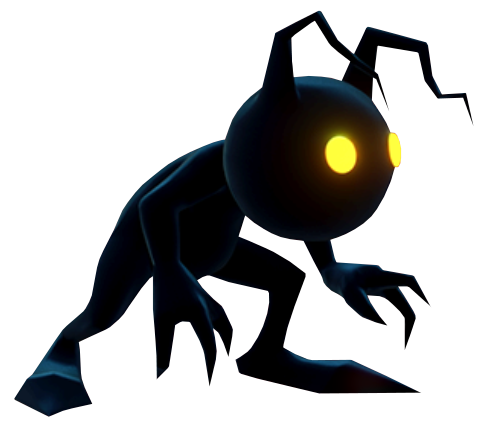
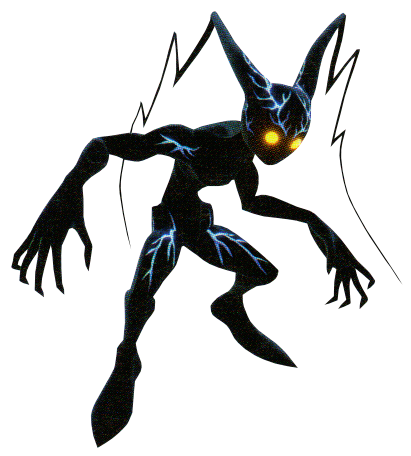
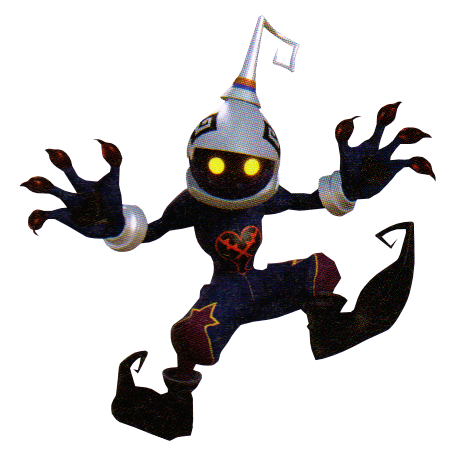
The things that came at them out of the street were shaped wrong and moved worse. "They've gotta be Heartless," Xehanort said.
They were, and the class dealt with them, and afterwards Xehanort looked at what was left and said, "Not bad for our first battle."
After that the search stopped being an adventure and became work.
There was a place of playing cards, with a queen in it. There was a wood, with a queen in it too, and a mirror. There was a castle, and a coliseum. They went to all of them and asked and fought and moved on, and the upper classmen were not in any of them.
Eraqus and Bragi went missing out of the group somewhere along the way, and Xehanort, Hermod and Urd had to go back to the desert city to look for them.
Bragi was the one they worried about least. He never got separated by accident. He was never where the trouble was and never far from it either, and when they found him he was generally already where they had been going. He was the quiet one, and a quiet one in a class that size gets read as shy, and nobody looked at him twice.
They found them. That was the pattern of those months. Losing people and finding them again, and each time the finding took a little longer.
It was during that stretch that Eraqus did the thing he was best at.
Going from world to world, finding nothing, and the arithmetic getting worse every time they arrived somewhere and nobody was in it. Eraqus kept the rest of them from working out how badly it was going, and he kept it up for as long as the search lasted.
Vor was separated from the rest and came across the mirror.
It was set in a frame ringed with chiselled tiles carrying the twelve signs, and the face that came up in the glass was a white theatre mask, lit so that half of it read darker than the other half. High-set eyebrows. Holes where the eyes should be, and a hole for the mouth, and the back of the face black.
It answered any question truthfully. It also answered cryptically, and the two together made it less useful than it sounded.
When the rest of them caught up and put the question to it, it told them the upper classmen were each acting alone.
Nobody knew what to do with that. It did not sound like people who had been taken.
Somewhere in the middle of all this Xehanort started saying things the others did not say. "Darkness can hide anywhere," he said to Eraqus. "Even inside someone."
It sounded like a general remark. "I wonder," Xehanort said. "Could darkness burrow so deep into someone's heart that they don't even know it's there?"
Eraqus asked him how he knew a thing like that. "Me? I..."
He did not finish it.
Later, and not as an answer to anything, he said: "One day we might have to decide."
The Darkness That Was His Own
Baldr had a sister among the upper classmen.
Hoder had the same white hair he did, short and feathery, and the same silver eyes. A collared white dress trimmed in black with a diamond cut out of the front of it, the hem uneven, ending at the thigh on the right under a thick gold band and falling to the calf on the left. A gold sash tied in a wide bow behind her, a black cord over it, a gold charm at the front. Black boots to the thigh with red cords crossing in an X at the tops.
Nothing was put into Baldr from outside.
He could feel the darkness in other people's hearts. All of them had some. And he could feel the other thing too, the way they held onto the light and would not hear a word said against it, and the harder they held the more clearly he could feel what they were holding it against.
And it grew. It grew in him, out of what he could feel in everybody else, until it was not a thing he was sensing any more. It was his.
When it had all of him, he intended to kill thirteen lights and summon Kingdom Hearts.
Hermod and Urd went into a corridor of darkness. They did not choose to; they were drawn in.
They were looking for Baldr, at the end of it, and they found him.
Hermod with his hair never quite in order and his olive robe and his boots tipped with gold. Urd with her ponytail and her flared black sleeves. They had sat in the same room as Xehanort every day since he came to the city.
He attacked them with darkness and killed them both.
Soon afterwards he struck Vor down.
She was the short one. She was the one who had got separated and found the mirror, and had brought the rest of them to it.
Xehanort and Eraqus got to her before she went.
There was time. Enough of it to reach her, and to understand what was happening, and to say goodbye, and none at all to do anything about it. So they said goodbye. Both of them were crying while they did it. She faded while they were still talking to her.
Bragi was counted among the dead. A stone went up for him with the others.
Hoder went first.
At the end she was reaching out toward her brother, and she faded into light while her arm was still up.
Vidar came for Baldr when he heard.
He was one of the upper classmen. So had Hoder been. The lower classmen had spent the better part of two years going from world to world looking for people like these two, and in the end had not found them so much as been overtaken by what had happened to them.
He was an upper classman, dark-skinned, with hazel eyes and short brown hair swept back. A dusty blue coat trimmed in gold, cut in the manner of a kamishimo, the short sleeves standing out over the shoulders. A black sash at the waist with a long yellow one wound over it and tied off at the left. A high-collared black shirt beneath, baggy black trousers into tall black boots with pointed tops and gold at the trim. A white charm on a silver chain at his waist. Long fingerless black gloves, the right one shorter with two bands above it on the arm, the left buckled, crossed with gold chain, the cuffs darker, white bandages wound over the top.
He was also the one who worked it out.
The darkness had taken Baldr as a vessel. It could not be reached any other way. The only method of destroying it was to destroy the body it was standing in, which meant killing Baldr, which meant that the thing they had been trying to save was the thing in the way.
He gathered the others and they went to do it and they were killed.
Vidar lived long enough to apologise, and to hand the job to Xehanort.
Which left Xehanort.
He found Baldr where the others had found him, and Baldr was still wearing the white jacket with the very large hood and the gold clasp, and his hair was still white and feathery and shorter at the front where it framed his face, and nothing about him had changed at all.
He had grown up being told that darkness came from outside and could be recognised and pushed back out again. Here was a boy he had sat in a room with for years, looking exactly like a boy he had sat in a room with for years, with their classmates dead behind him and his sister gone into the light with her hand still up.
Baldr said something.
Then Xehanort struck him down.
He made no attempt to save him. Somebody had tried that, and had died inside the attempt, and had handed what was left of it to him.
Whatever it was, Xehanort carried it out of that room, and he was still carrying it years later, and it had not got any lighter.
The Graveyard
Xehanort shut himself in his room for a month.
On the far side of the city there was a graveyard, a long one, and it took the four of them. Hermod. Urd. Vor. And a stone for Bragi, who had been counted among them.
Eraqus went there. Xehanort went there too, eventually, and they found each other among the stones rather than anywhere either of them had chosen, and that was where the month ended. They talked. They agreed to go on with the training.
They had not spoken since the graves went in.
Four stones. Hermod, Urd, Vor, and one with Bragi's name cut into it over nobody.
Eraqus stood in front of them still believing that darkness was a thing that could be got rid of. Xehanort stood in front of the same four stones and went somewhere else with it. Neither of them said so. They agreed to go on with the training, and that was the whole of the conversation.
A month after the burials, a man walked through that graveyard on his own.
Nobody saw him. The place was empty.
He went along the row without hurrying, and stopped, and put his hood back.
The face under it was Bragi's.
He remarked, to himself, that having died was going to make it difficult to go about showing it.
There had never been a Bragi. There had been a body with somebody inside it, enrolled among the lower classmen, going out on the search with the rest of them, and then a death, and a stone.
None of them ever found out. Not Eraqus, not Odin, not Xehanort. The stone stayed up.
Thirteen Lifetimes
Xehanort took something out of it that nobody expected.
He had watched a boy grow his own darkness out of standing close to people who would not admit theirs. Nobody had put it into Baldr. It had come up in him because he could feel what everybody around him was holding down, and because they held it down so hard, and so certainly, and called what they were doing the light.
So he stopped believing in the light they meant. Not in light. In that light, the one the world held up, which he had now watched conceal something until the thing it was concealing killed his friends.
A false light was what he called it, and having named it he decided to do something about it.
He told Eraqus what he thought.
The world needed rebuilding rather than repairing. The whole arrangement of it was wrong in the way a foundation is wrong, and putting it right would take longer than a person got. So he would want more than a person got. He would extend his own life, do the work, and then be there afterwards to live in the thing he had made.
They were sitting somewhere above the water when it came round to it properly. "It made me think, about a lot of things," Xehanort said. "The events of the past, what's to come. What about you? Wasn't it always your dream to travel abroad on your own?"
Eraqus said that what he wanted now was to stay true to the light. "Hm?" Xehanort said. "What brought that on?"
So Eraqus told him. He wanted to be a beacon: to stand where the people who were lost in the darkness could see him, and to bring them back out of it. He said it in a way that left room for Xehanort to be one of them. "I see," Xehanort said.
He let it sit. Then: "It made me realize that one lifetime is too short. It's not enough."
Eraqus asked him how many he wanted. "Hmm," Xehanort said. "Twelve. No, thirteen. That's what it'll take to rebuild the world."
Then he thought about it a moment longer.
"Scratch that. One more to explore the new world."
Odin meant to stand down.
He said so. The plan was for the two of them to replace him, and for him to retire somewhere that was not this city.
He arranged for them to sit the examination early.
Seven years after Xehanort had come out of a corridor of darkness into a city standing on water, the two of them passed it, and were made Keyblade Masters on the same day.
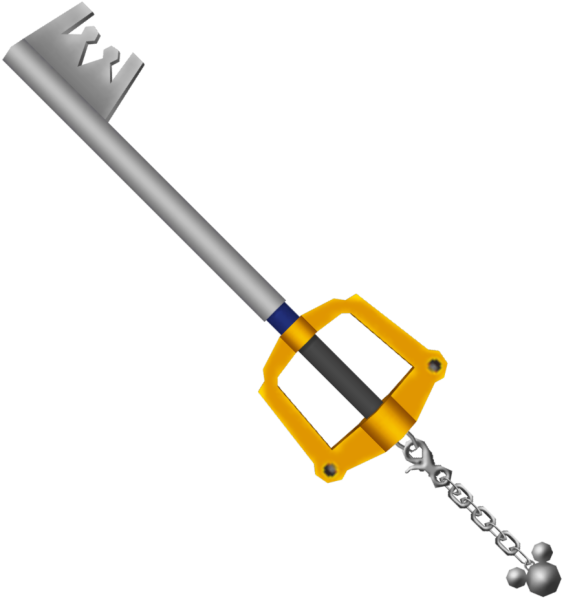
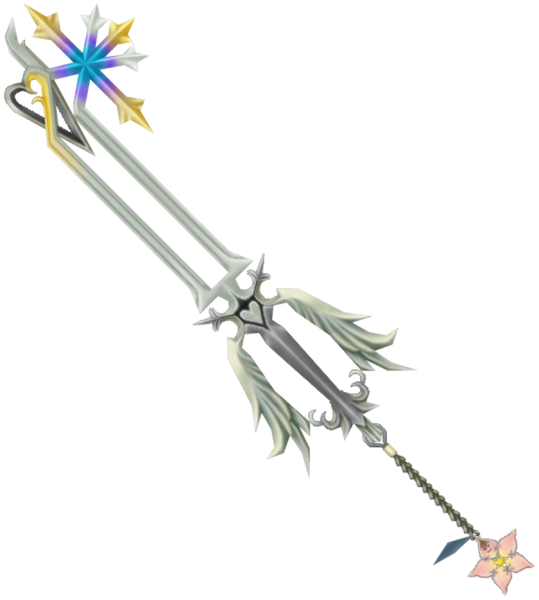
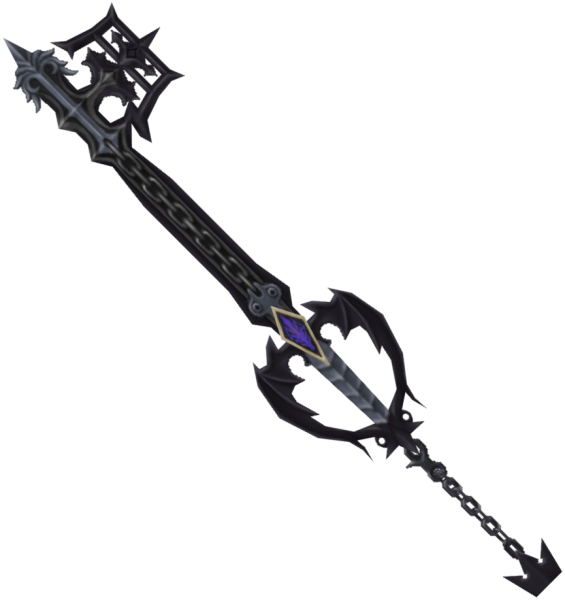
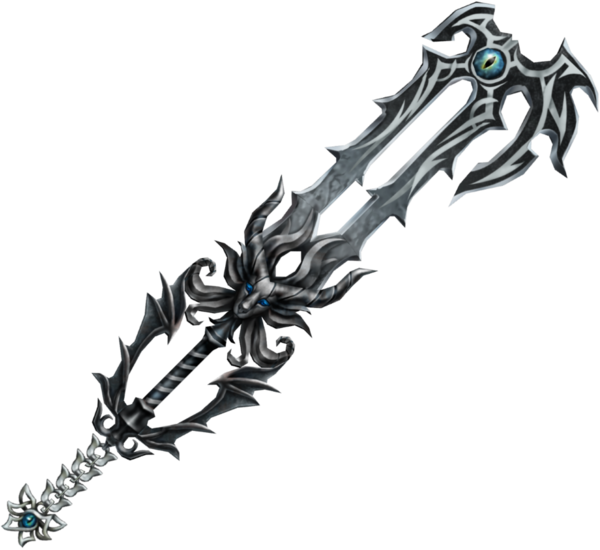
They were given weapons.
Eraqus, who was called the true heir, was given the Master's Defender.
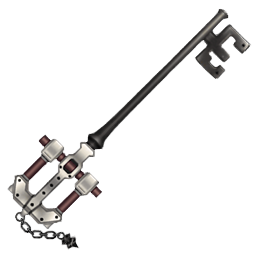
Xehanort was given the No Name.
A year later they fought each other.
It came out of what Xehanort intended to do about the false light, which by then he had worked out in detail, and the detail was this: he was going to summon Kingdom Hearts. "Kingdom Hearts is the only way," he said.
Eraqus had been arguing with him for some time before that and he did not stop. "What about our duty as Keyblade wielders?" he said.
Xehanort was gathering his things while it went on, which did not help. "To think we became Keyblade Masters only a year ago, and now this."
He tried the weapon next, because the weapon was the argument he thought could not be answered. "You were bequeathed a Keyblade from the era of the Lost Masters. You were supposed to have inherited their weapon, and their resolve."
Xehanort let that one go by as well. "But summoning Kingdom Hearts is a drastic measure," Eraqus said. "How can you be so sure that's the answer?"
There was not a reason that would survive being said out loud to somebody who believed what Eraqus believed, so Xehanort did not offer one. "Life has taught us far different lessons," Eraqus said, and brought his Keyblade up.
Xehanort looked at it. "Do you stand in my way as a true Keyblade Master?"
"No," Eraqus said. "As a true friend."
Then he attacked him.
The two blades came together.
Xehanort left. "We all have our dreams," he said, on his way.
And at the last, with everything between them where it now was, and both of them Masters, and a year gone since the ceremony, and four stones on the far side of the town:
"See you."
The Mirror
A long time passed.
Enough of it that the boy who had walked out of a corridor onto a strange pavement was an old man, and the city had gone on turning its windmills without him, and most of the people who could have said what he had been like as a student were under stones.
He went back to the mirror.
The white mask came up in the glass the way it always had, lit unevenly, the eyes and the mouth two holes and nothing behind them, the twelve signs standing round the frame.
He had a question ready. He had had it ready for a very long time.
He asked it whether the friends in his dreams had truly existed at all.